
Connecting Agriculture, Hospitality, and Tourism: Garden to Glass Value Chain at U.W.I.
- Green Bartender
- May 11
- 3 min read

Updated: May 12
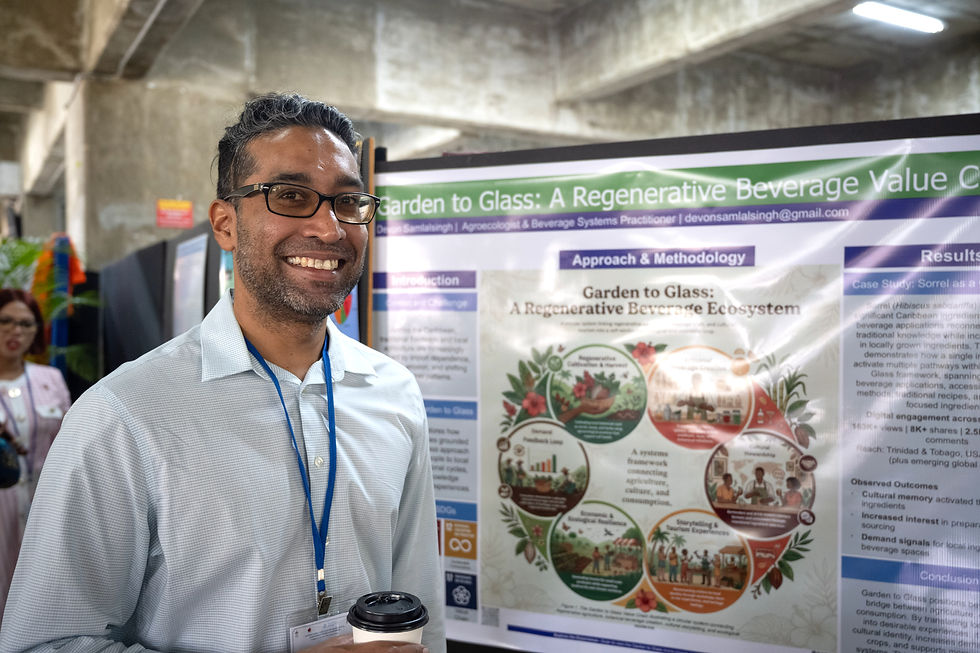
The Food and Nutrition Security and Sustainable Tourism Conference hosted by The University of the West Indies reinforced how interconnected food security, tourism, agriculture, and hospitality systems have become within Caribbean contexts.
Within that space, the Garden‑to‑Glass Value Chain emerged as a framework showing how regenerative agriculture, ethnobotanical ingredients, hospitality, and cultural storytelling can operate together as part of a connected system of ecological, cultural, and economic value creation.
The conference explored the theme: “From Soil to Society: Advancing Food and Nutrition Security, Cultural Gastronomy, and Sustainable Tourism to achieve the SDGs.”
My contribution was developed under the sub‑theme: “Sustainable Gastronomy Tourism: Business Models for Community Resilience and Visitor Experience.”
This framing examined how food, culture, tourism, and local economies can become more interconnected and resilient within Caribbean contexts.
What is the Garden to Glass Value Chain?
At its core, the Garden to Glass Value Chain is a framework that connects:
regenerative agriculture
ethnobotanical ingredients
ingredient transformation
beverage creation
cultural practice
community impact
into a continuous cycle of ecological, cultural, and economic value.
Instead of treating beverages as mere end products, the framework traces the full journey of ingredients — from cultivation and harvesting into hospitality‑ready formats such as syrups, infusions, cocktails, and non‑alcoholic applications — while emphasizing the relationships between farmers, hospitality professionals, educators, and local communities.

This approach grew out of years of working across agricultural and hospitality environments, observing how local biodiversity, tourism, beverage culture, and food systems continuously influence one another. By situating beverages within this loop, Garden‑to‑Glass highlights how crops like sorrel, sapodilla, citrus, herbs, and spices can move through hospitality‑ready formats to elevate cultural identity while generating tangible economic value.
Within Small Island contexts, these connections become especially important as tourism, agriculture, biodiversity, and cultural identity remain deeply interconnected.
Agriculture, Hospitality, and Tourism as Connected Systems
A highlight of the conference was the introduction of beverages as more than hospitality products, situating them within wider conversations around food security, sustainability, and tourism development.
Too often, agriculture and hospitality operate in parallel while remaining disconnected. Garden to Glass brought this concept to attention exploring what becomes possible when these sectors intentionally reconnect through ingredient sourcing, storytelling, transformation, and experiential design.
It raises questions like:
How can local ingredients become more visible within hospitality spaces?
How can beverage systems support farmers and small producers?
What role does storytelling play in strengthening cultural identity through food and drink?
How can regenerative practices become economically viable through value‑added applications?
These conversations are especially relevant in the Caribbean, where biodiversity, cultural knowledge, and tourism economies intersect in unique ways.

The experience included a poster presentation and plenary discussions exploring the evolving relationship between agriculture, hospitality, tourism, and sustainability across the region. The plenary session brought together perspectives from hospitality, tourism, and beverage systems, with discussions led by Chef Adrian Cumberbatch, joined by representatives from Tourism Trinidad Limited, restaurateur Mickel Maraj, and Devon Samlalsingh — founder of Green Bartender. These conversations reinforced the growing interest in approaches that move beyond isolated industries and instead focus on connected regional systems.
Moving Forward
The Garden‑to‑Glass Value Chain is not only a framework for beverage craft but also a lens for understanding how Caribbean food systems can regenerate themselves through cultural storytelling, ecological stewardship, and hospitality innovation. The conference underscored that beverages are more than products or experiences — they can serve as bridges between agriculture, tourism, and community identity, helping to shape resilient futures for Small Island contexts.

To explore the Garden to Glass Value Chain further:
For readers interested in the complete visual presentation and supporting framework, the full poster presentation from the conference can be viewed below.
Interested in learning the foundations of botanical beverages and ingredient transformation? Scan the QR code below

Comments